Skydiving from 4,000 metres: how long it lasts and how fast you fall
About a minute of freefall, a few minutes under the parachute, and what happens in between, second by second.
On this page
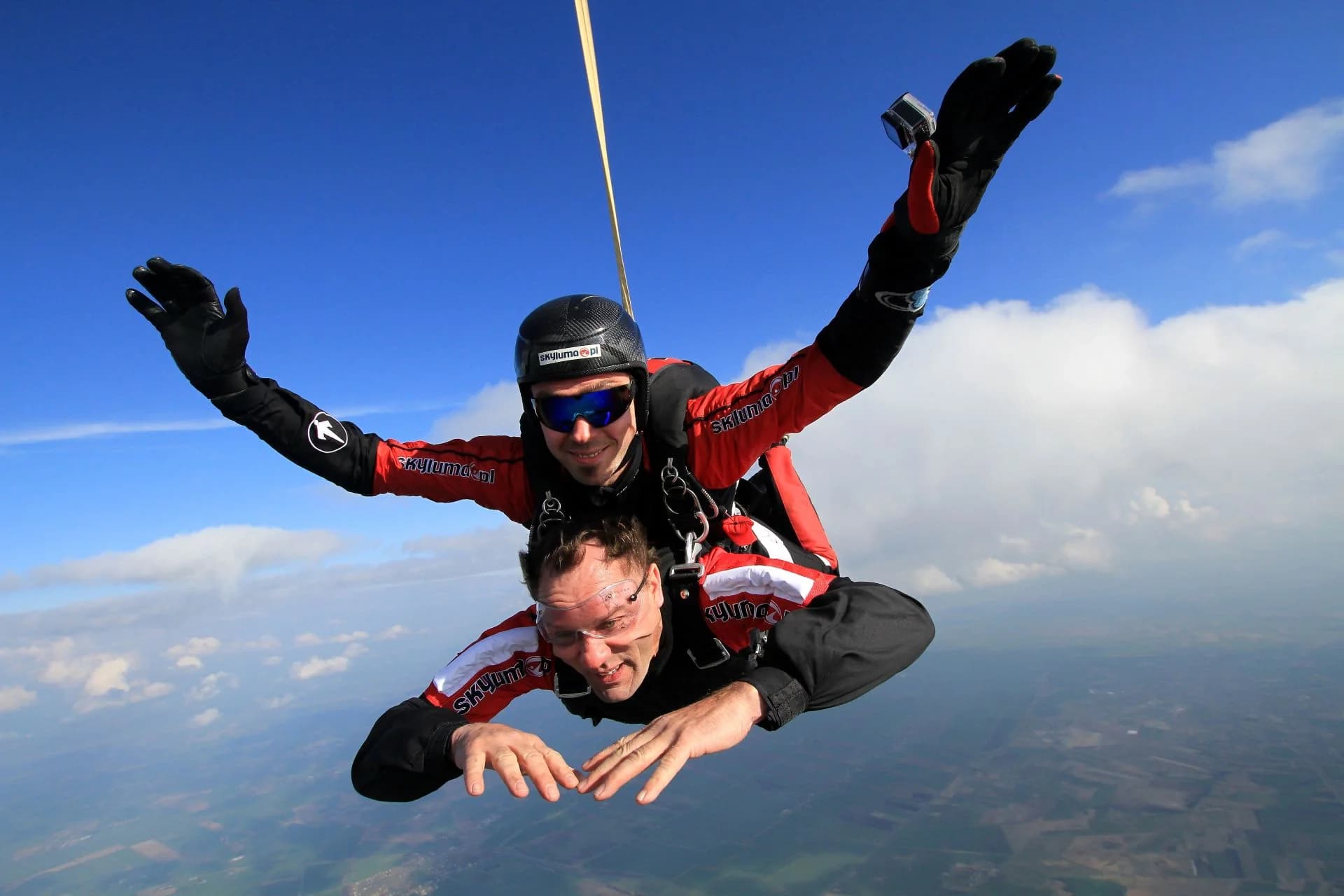
4,000 metres is 4 kilometres, or about 13,100 feet. Pilots and most altimeters work in feet, so that is the number you will hear in the plane. A tandem jump from this height has two parts: about a minute of freefall at up to 200 km/h, and a few minutes of calm flight under an open parachute.
One jump, step by step
- 01Exit at 4,000 metres. For the first few seconds you feel the airflow from the front, from the direction the plane is flying, and only then from below.
- 02Acceleration. The American USPA reckons the first 300 metres take about 10 seconds, until the body reaches a steady speed.
- 03The stabilising parachute. Shortly after the exit the instructor throws out a small parachute that holds you at around 200 km/h. Without it, two people would fall noticeably faster than one.
- 04Freefall. At that speed every 1,000 metres takes roughly 18 seconds.
- 05Opening at around 1,500 metres. In a tandem the parachute opens at about the same height on every jump. Within a few seconds you slow to the canopy's flying speed.
- 06A few minutes under the parachute. It is quiet, you can talk, and if conditions allow you can steer the parachute for a while under the instructor's eye.
- 07Landing. You lift your legs as practised on the ground, and the instructor does the rest.
Where “about a minute” comes from
From 4,000 metres to the opening height there are about 2,500 metres. At 200 km/h, about 55 metres a second, that is around 45 seconds, plus a few seconds of acceleration after the exit. Together it comes close to a minute, which is where the round “about 60 seconds” in jump descriptions comes from. The exact time depends on the opening height and on how much the pair weighs.
The same arithmetic shows what a lower exit costs. The manual for the UPT Sigma 2 system we jump allows an exit from as low as 2,300 metres, but then the freefall lasts only a dozen or so seconds. That is why the first question when comparing offers is: from what height. More in the guide to prices.
How fast you fall
A body in the air accelerates until drag equals weight. From then on the speed stops rising; this is called terminal velocity. A skydiver lying belly to earth falls at roughly 190–200 km/h: USPA uses 120 miles an hour, about 193 km/h, for logging freefall time. A tandem without the stabilising parachute would fall faster, because two people carry more mass with little more drag.
Body position changes everything. Skydivers flying head down typically reach about 175 miles an hour according to USPA, around 280 km/h, and USPA describes speed skydivers of whom a few exceed 300 miles an hour, about 480 km/h. That is a separate discipline for experienced skydivers, though, not a tandem jump.
Why 4,000 metres
Higher means longer, but not indefinitely. Above 15,000 feet above sea level, about 4,570 metres, American regulations and USPA rules require oxygen on board. The British federation describes tandem jumps from 8,000 to 15,000 feet as made without supplementary oxygen. 4,000 metres sits near the top of that range and gives the longest freefall without oxygen masks.
What you feel on the way
- Pressure. At 4,000 metres it is about 40% lower than on the ground, and it comes back quickly during the fall. A healthy ear equalises on its own or when you swallow.
- Cold. At jump altitude it is usually about 25 degrees colder than on the ground. That lasts about a minute, and under the canopy it gets warmer with every hundred metres.
- Breathing. You can breathe normally. If nerves make you hold your breath, shout: shouting forces an out-breath, and the in-breath follows by itself.
- The view. The wide landscape only settles once you are under the parachute. How far you can see from this height is worked out in the guide to the view from 4,000 metres.
If you have trouble with your ears, sinuses, heart or lungs, read the page on medical conditions and skydiving before you buy a jump.
How long the whole day takes
The jump itself, from exit to landing, takes a few minutes. At the drop zone, though, plan a few hours and nothing fixed for the rest of the day, because the order of the lifts follows the weather. How long the climb to altitude takes depends on the aircraft and its load. We write about that on the skydiving aircraft page.
And the highest jumps ever?
Felix Baumgartner jumped from almost 39 kilometres in 2012, and Alan Eustace from over 41 kilometres in 2014. Both wore pressure suits and were carried into the stratosphere by balloon. A jump from 4,000 metres is roughly a tenth of that height and a different thing altogether: no pressure suit, no oxygen and an instructor strapped to your back.
Read next
Frequently asked questions
How long does a skydive from 4,000 metres take?
About a minute of freefall and a few minutes of flight under an open parachute. From exit to landing it is a few minutes, but plan a few hours at the drop zone.
How fast do you fall when skydiving?
In a tandem, about 200 km/h. That is the speed held by the small stabilising parachute the instructor throws out shortly after the exit.
At what height does a tandem parachute open?
Around 1,500 metres above the ground. The American USPA sets a minimum of 5,000 feet, about 1,520 metres, for tandems.
How many feet is 4,000 metres?
About 13,100 feet. Pilots and most skydiving altimeters give height in feet.
Is there enough oxygen at 4,000 metres?
Air pressure there is about 40% lower than on the ground, but the jump is short. American regulations only require oxygen on board above about 4,570 metres. With a heart or lung condition, ask your doctor before you buy.
Who made the highest skydive?
Alan Eustace in 2014, from over 41 kilometres. Two years earlier Felix Baumgartner jumped from almost 39 kilometres. Both wore pressure suits.