Is skydiving safe?
The honest answer is that it is not free of risk, and nobody serious will tell you otherwise. What is worth knowing is where the risk sits and what is done about it.
On this page
Skydiving is an air sport and carries risk that cannot be reduced to zero. Anyone claiming otherwise is selling something other than a skydive. The useful question is therefore not whether it is safe, but what specifically stands between the jumper and the things that can go wrong.
A tandem is a different situation from a solo jump
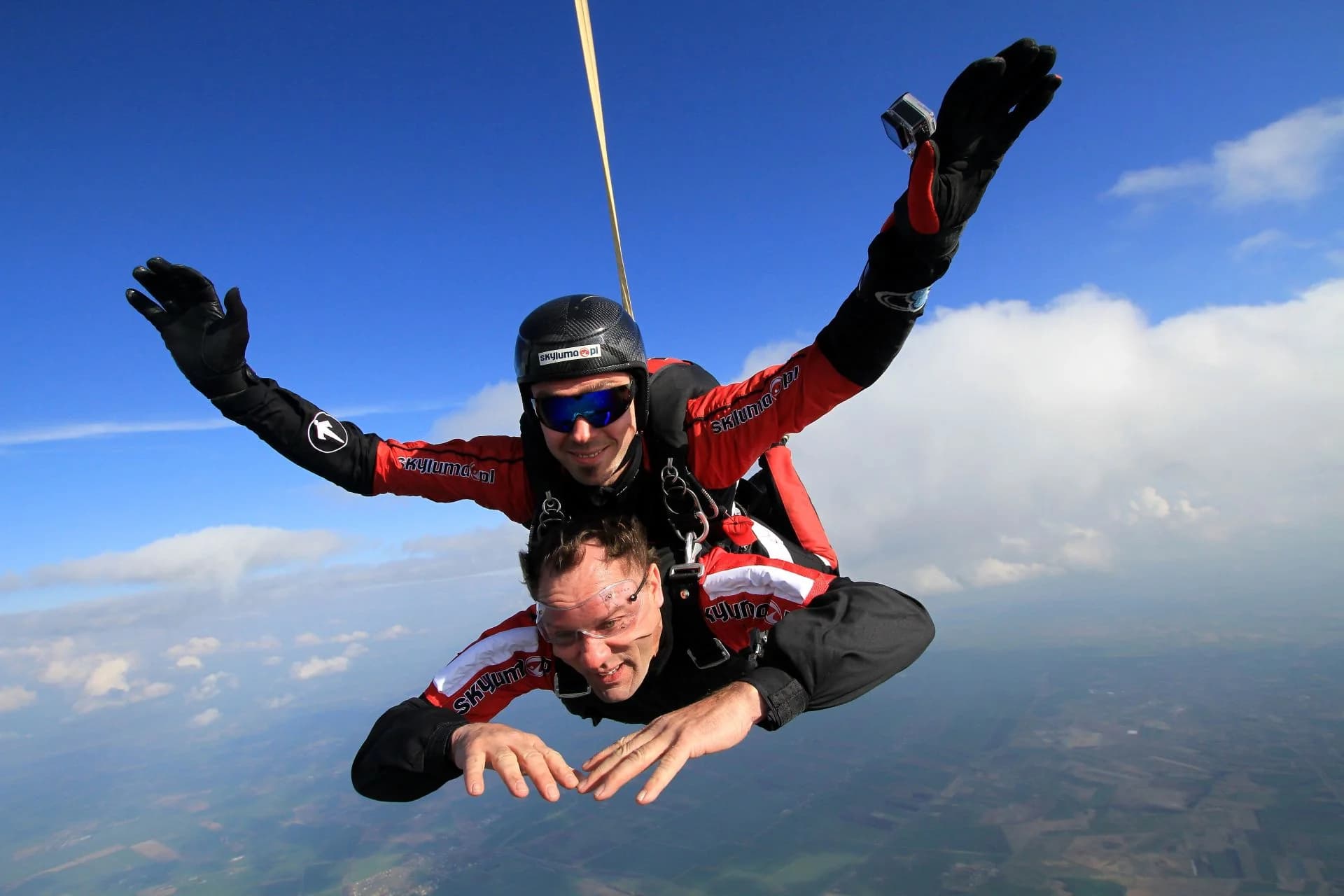
In a tandem you make no technical decision at all. You do not deploy the canopy, you do not fly it, you do not choose the landing area and you do not assess the conditions. All of that belongs to the instructor, to whose harness you are attached at four points. Your job comes down to body position at the exit and lifting your legs for the landing — and you learn both in a quarter of an hour on the ground.
This is the fundamental difference from the AFF course, where you are responsible for yourself from the first jump. It is why a tandem is the right form of first jump for somebody who is not planning to carry on.
Two parachutes, not one
Every rig carries a main canopy and a reserve. The reserve is a separate, independent parachute, packed by a qualified person, and it exists for exactly the situation where the main does not behave. Transferring to it is a drilled procedure, part of every skydiver's training and part of a tandem instructor's routine.
The equipment
We jump the latest UPT Sigma 2 tandem system.
Automatic activation devices
Every tandem rig carries an automatic activation device for the reserve.
The instructors
Tandem jumps here are flown by experienced instructors holding tandem ratings.
The weather is part of safety, not an obstacle to it
A cancelled jump reads as an inconvenience and is a safety decision. Whether jumping happens is decided by the dropzone on the day: wind at ground level and at altitude, cloud base, visibility. When conditions fall outside the range, jumping stops — and that mechanism is precisely why the statistics look the way they do.
For somebody holding a voucher it means one thing: the date can move. The voucher does not lose its validity and the new date costs nothing.
Health: what actually rules you out
A tandem jump does not require a medical certificate — you sign a declaration that there are no contraindications. That does not mean there are none.
- Heart and circulatory conditions, including uncontrolled high blood pressure.
- Epilepsy and disorders of consciousness.
- Recent injuries, particularly to the spine, shoulders and knees — the landing is dynamic.
- Recovery from recent surgery.
- Pregnancy.
- Sinus and ear problems that make equalising difficult.
This list does not replace a conversation with a doctor. If you have any doubt, a doctor settles it — not a form on a website and not an instructor at the dropzone.
Alcohol and other substances
Anyone under the influence of alcohol or drugs will not be cleared to jump. This is not a judgement call — it is a condition on which an instructor has no room to manoeuvre. If the jump is part of a longer day, put it at the beginning.
What people fear, and where the risk actually is
The most common fear is the parachute not opening. That is also the part with a duplicated system and a drilled procedure behind it. Statistically the landing deserves more of your attention — it is where the common injuries happen, and where your single instruction from the ground, lifting your legs, genuinely matters. There is more about the fear itself in a separate guide.
Read next
Frequently asked questions
What happens if the parachute does not open?
Every rig carries a second, independent parachute — the reserve. Transferring to it is a drilled procedure, not improvisation.
Do I need a medical certificate?
Not for a tandem jump. You sign a declaration that there are no contraindications. Where there is doubt, a doctor decides.
Can I jump after surgery or with an injury?
Recent injuries and post-operative recovery are contraindications — the landing is dynamic. That is a question for your doctor.
Who decides whether jumping happens on the day?
The dropzone, based on the conditions: wind, cloud base and visibility. Jumping that is stood down is rescheduled.
Is a tandem safer than jumping solo?
It is a different situation: in a tandem the jumper makes no technical decision. Equipment, conditions, deployment and landing all belong to the instructor.