Tandem or AFF — where to start
Two different paths. One takes a day; the other starts something that lasts years.
On this page
The question comes back every time someone first thinks about jumping, and the answer is simpler than it looks: a tandem if you want to experience it, AFF if you want to do it. This guide is about the decision itself. The training is described on the AFF course page, and what comes after it in the guide after the AFF course.
Tandem
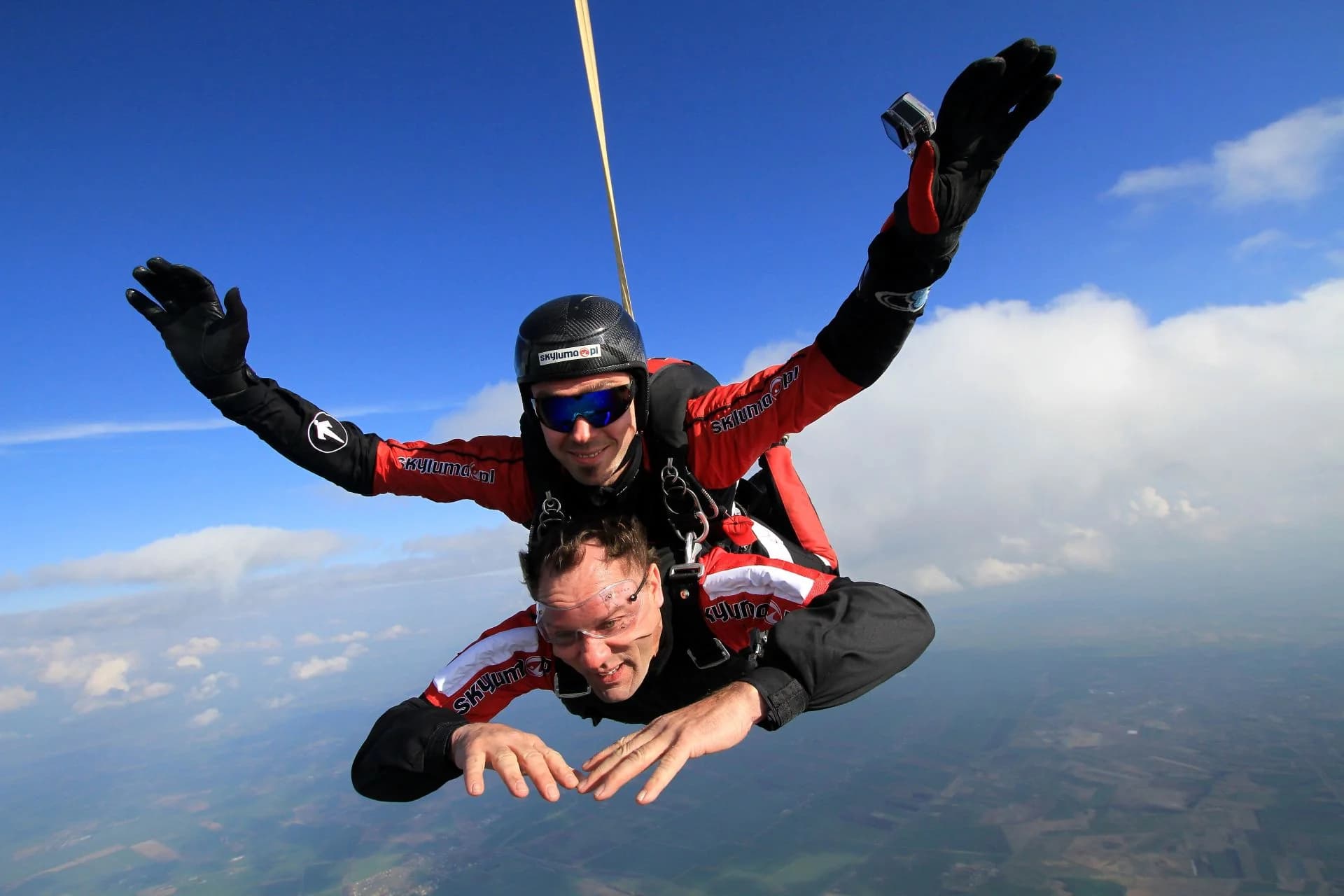
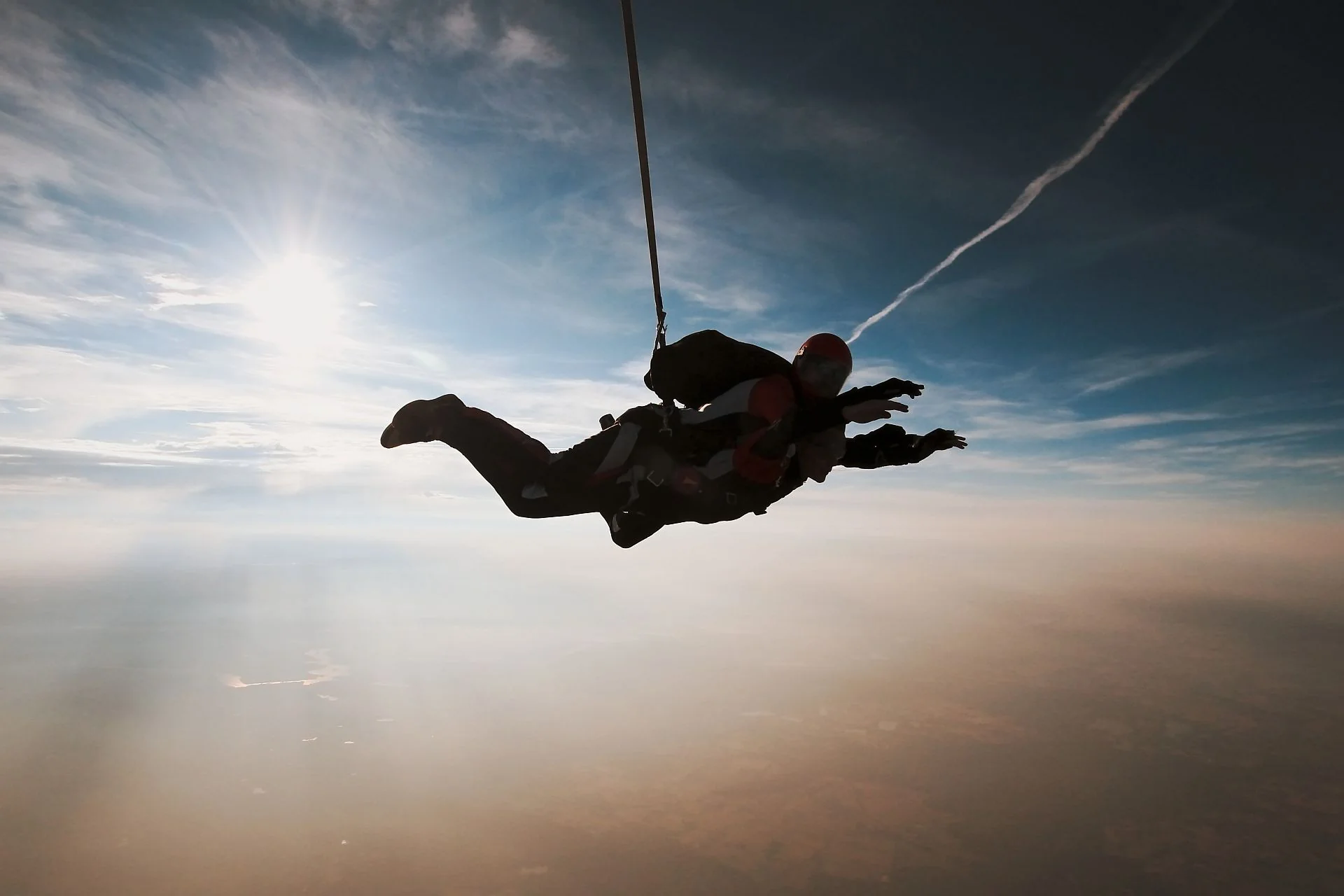
You are attached at four points to the instructor’s harness, and the instructor handles everything: the exit, the freefall, opening the parachute and the landing. On the ground, in about a quarter of an hour, you learn two things: how to hold your body as you leave the aircraft and how to lift your legs for the landing. From 4,000 metres that means about a minute of freefall at up to 200 km/h, then several minutes under an open canopy. It costs from 1,150 zł and fits into a single day at the dropzone.
The AFF course
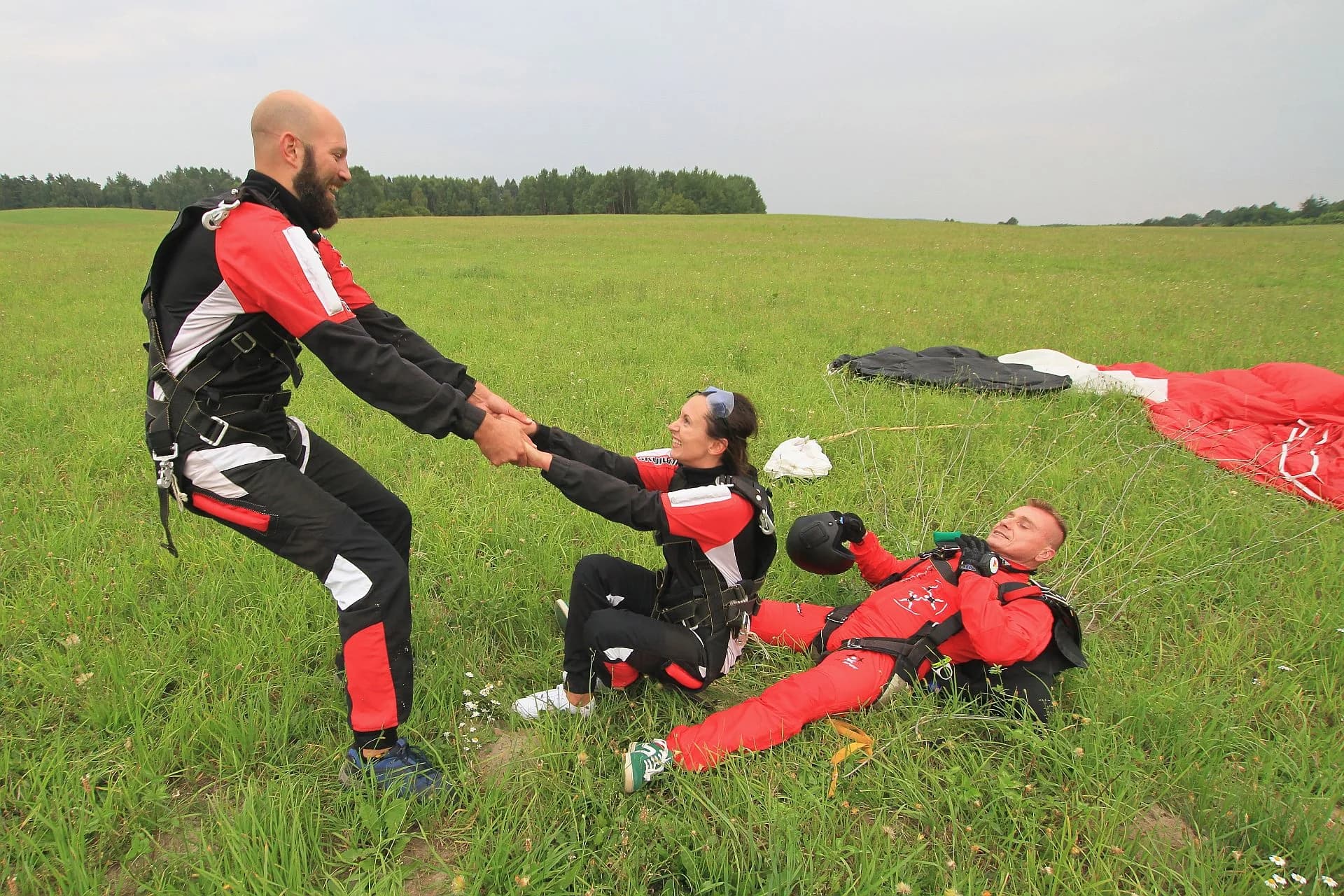
AFF (Accelerated FreeFall) starts with ground school: how the parachute is built, procedures, emergencies and landing. From the first jump you wear your own parachute and fly it yourself, while instructors fall alongside you and correct your body position. Each jump hands you more independence, and once you have passed the programme you jump on your own. The course runs over several jumping days and costs 6,900 zł.
The differences that matter
- Responsibility: entirely the instructor’s on a tandem; on AFF it passes to you, jump by jump.
- Preparation: a quarter of an hour of briefing for a tandem; full ground school for AFF.
- Time: a tandem is one day; AFF is several jumping days, not necessarily consecutive.
- Age: no minimum for a tandem, with a legal guardian’s written consent under 18; AFF from 16, with the same consent until 18.
- Cost: a tandem from 1,150 zł; the AFF course 6,900 zł, with further jumps paid for one at a time afterwards.
- What you keep: from a tandem, a memory and a video if you order one; from AFF, a skill.
Same minute, different job
On a tandem, freefall is something you watch. The instructor decides when to leave, keeps track of the altitude and opens the parachute, and you look around. On a first AFF jump the same minute is full of tasks: you check your heading and your altimeter, look for both instructors, reach for the deployment handle in practice, and at the agreed altitude you open the parachute yourself. Under the canopy you fly on your own as well, to the landing area. What such a jump looks like step by step is set out on the AFF course page.
What each path costs
A tandem is a single outlay: 1,150 zł, or from 1,350 zł with footage. The AFF course costs 6,900 zł, and it is where the spending starts rather than all of it. Polish rules require at least 50 freefall jumps for the parachutist’s qualification certificate, commonly called the licence. That leaves a few dozen jumps after the course, and after those you keep jumping.
A single jump after the course costs several times less than a tandem, but there are a lot of them. So you are really comparing one day with a sport that has running costs. They are broken down in the guide after the AFF course.
Do you need a tandem first?
There is no such requirement. The AFF course is designed for people starting from zero, and you can sign up without any previous jump.
Nor is a tandem the first stage of the course. Under Polish rules a tandem passenger is not a student parachutist, so a tandem jump is not part of the training. It is a separate jump with a separate purpose.
That purpose is finding out about yourself. A tandem before the course costs 1,150 zł, a sixth of the course price, and it answers one question: how you take the flight, the open door, the noise and a minute of freefall. If that minute is not for you, you learn it for 1,150 zł rather than 6,900 zł. The second question, whether you can carry out tasks on your own in that rush of air, only the first jump of the course can answer.
Starting with a tandem makes sense if you do not know how you will react to the height, or if 6,900 zł is a decision you would rather test first. You can go straight to the course if you already have a tandem behind you, or if you simply know that you want to learn.
There is also a third way to test yourself: a wind tunnel. It teaches you to hold a position in a column of moving air, which is what AFF practises in freefall, but it shows you no aircraft, no open door and no height.
As a gift
Almost always a tandem. It asks the recipient only to turn up and to meet the requirements: a weight of up to 100 kg and no medical contraindications. The voucher is valid for 12 months and made out to the bearer, and the date is chosen after purchase.
An AFF course makes sense as a gift only for someone who has said themselves that they want to learn. It means several jumping days, theory and practical assessments, and the recipient has to be at least 16. More on giving a jump is on the gift voucher page.
Read next
Frequently asked questions
How is a tandem different from AFF?
On a tandem you are attached to an instructor and need no skills. On AFF, after ground school, you wear your own parachute from the first jump, open it yourself and fly it yourself, with instructors falling alongside you.
Do I need a tandem jump before an AFF course?
No. You can start AFF with no previous jumps, although many people do a tandem first to see how they react.
Which is cheaper?
A tandem, from 1,150 zł a jump. The AFF course costs 6,900 zł and leads to jumping on your own, after which further jumps are paid for one at a time.
Does a tandem jump count towards the AFF course?
No. Under Polish rules a tandem passenger is not a student parachutist, so a tandem is a separate jump and the training only begins on the course.
How old do you have to be for a tandem, and for AFF?
A tandem has no minimum age; anyone under 18 needs written consent from a legal guardian. The AFF course starts at 16, also with a guardian’s written consent until 18.
Is an AFF course a good gift?
Only for someone who wants to learn to jump. The course means several jumping days, theory and practical assessments. For someone who wants to experience a single jump, a tandem is the better gift.