Skydiving on the Baltic coast
A tandem jump from 4,000 metres, a few dozen kilometres inland. The sea is what you look at, not what you fall towards.
On this page
A skydive over the sea is not what this is. You leave the aircraft at 4,000 metres over land, a few dozen kilometres inland; the Baltic and the Bay of Gdańsk lie along one side of the view rather than under you. We do not jump over water or along the beach — that is a different operation, with different permissions. From this height the water is on the horizon either way.
How much of it you see is settled by the air on the day, not by us. We promise no particular view, because a voucher is often bought months before the jump and nobody knows what the air will be doing by then. What we can say is which parts of this landscape hold longest, and what takes them away.
How the coast lies from up there
The dropzone sits inland, near Gdańsk, with the coast on one horizon and Kashubia on the other. From 4,000 metres you are not looking at towns or buildings; you are looking at shapes and at patches of different tone. These are the ones that read most reliably:
- Water: a different tone from the land in any light, darker on some days and brighter on others.
- The sand line: one of the hardest edges in the view, because nothing contrasts like bright sand against dark water.
- The Tricity: a grey band pinned between forest and shore, about thirty kilometres end to end.
- The Vistula delta: flat, drained and ruled into squares by its ditches and roads.
- The Vistula: wide enough to hold as a silver line long after a town has stopped being a town.
- Kashubia: dark forest with lakes scattered through it.
Water outlasts everything else in the view
Haze eats the small things first: field boundaries, ditches, the texture inside a town. Water stays, because water is not a detail. It is a large expanse of a different tone, and a bay tens of kilometres across does not shrink in haze. Most of the rest is seasonal or conditional — field colour changes every few weeks, and lying snow on this coast is not something to count on. Water is neither.
The limit is the air, not the height
Haze does not sit evenly. It usually lives in a shallow layer near the ground, and from 4,000 metres you are above it, which is why the ground below you can look sharp while the far horizon dissolves into a milky band. Looking down, you cross that layer once; looking sideways, you have its whole length in front of you. The near view is almost always the better one.
- Haze: the near view survives, the far shore softens and loses its edges.
- Sea fog: warm air sliding over a cold Baltic — the sky inland can be cloudless while the bay lies under a white lid.
- A solid cloud deck: it takes the landscape all at once rather than piece by piece.
- High overcast: the view stays, the light and the colour go.
A voucher is valid for 12 months, so you can wait for a clear day. Whether a jump runs at all is a separate question, and the guide on when we jump answers it.
What about jumping over the beach itself?
No variant on the price list puts you over the sand. What makes the sand line read at all is contrast — bright sand against dark water — and contrast carries across distance in a way that detail does not. In clear air the line holds from well inland. In exceptional visibility the Hel Peninsula shows as a thin thread across the bay — the weather's gift, not part of what you are buying.
What 4,000 metres does not give you
From 4,000 metres, geometry puts the horizon about 226 kilometres out. That is a ceiling, not a view. The range you actually get is set by the air, and it runs to tens of kilometres rather than hundreds. So a few claims that recur in skydiving copy do not hold here:
- The curvature of the Earth. The horizon sits two degrees below level and looks flat; curvature does not show below ten or fifteen kilometres.
- The far side of the Baltic. It lies beyond the horizon from here, so this one is geometry rather than weather.
- Individual buildings — a landmark tower, a port crane, your own house. At this range you get shapes and blocks of tone.
- Half of Poland, three regions at once, the whole of Pomerania. It sounds good and it is not true.
Freefall is not when you see any of this
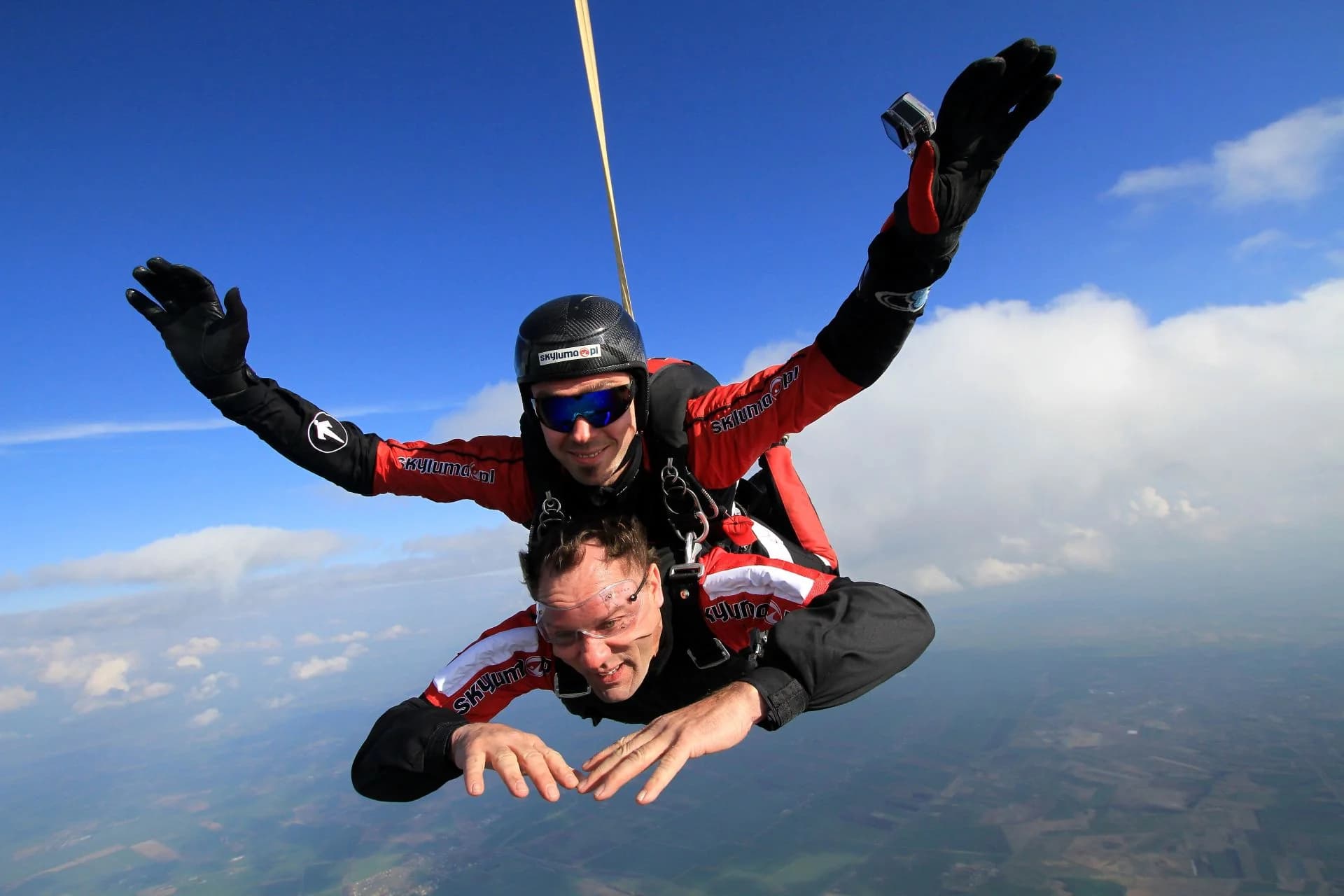
Freefall is about 60 seconds at up to 200 km/h, and it is loud and hectic. The horizon tilts, and what you get is wide and rushing rather than detailed. The landscape sorts itself out under an open canopy, over several minutes in which you can turn your head and choose what to look at. The other good stretch comes earlier, on the climb.
How far you can see falls away faster than you would think. What is in front of you at 4,000 metres and what is in front of you close to the ground are two different views, and by then the horizon is several times closer. The widest look is at the top; the most detail is at the bottom. There is a separate guide on what you can see from 4,000 metres.
If you are coming for the view
The thing that helps most costs nothing: the air is usually cleanest early, before the day has stirred it. Nothing on the price list charges for the view, and no variant buys a better one. The full list is on the pricing page; requirements, the day's running order and directions sit on skydiving near Gdańsk.
The filmed variant is the one that leaves you something to look at afterwards. The camera flyer exits with you and films from outside, so the landscape is behind you in the footage. That is 1,500 zł against 1,150 zł for the jump alone. The hand-cam at 1,700 zł adds a second camera in the instructor's hand, by your face — closer to you, not to the view.
Read next
Frequently asked questions
Can you skydive over the sea?
No, not over the water itself. We jump over land, a few dozen kilometres inland; the Baltic and the Bay of Gdańsk are on the horizon rather than under the aircraft.
Can you see the sea from 4,000 metres?
Yes, in good visibility. Water holds in the view longer than anything else, because it is a large expanse of a different tone rather than a small detail that haze can take.
Can you see the Hel Peninsula from the jump?
Sometimes, in exceptional visibility, as a thin thread of land across the bay. It is never something we promise when we sell a voucher.
Can you see the far side of the Baltic, or the curvature of the Earth?
No. The far shore lies beyond the horizon from this height, so weather does not come into it. Curvature does not either: at 4,000 metres the horizon sits two degrees below level and looks flat.
How much does a skydive on the Baltic coast cost?
1,150 zł for the tandem jump from 4,000 metres — the standard price, with no surcharge for the view. With a camera flyer it is 1,500 zł, and 1,700 zł with an additional instructor hand-cam.