What you can see from 4,000 metres
The geometry allows 226 kilometres. The air leaves you tens of kilometres — and that gap is the honest answer.
On this page
From 4,000 metres the horizon is about 226 kilometres off. That figure is pure geometry and nothing else. What decides the view is the air, not the curve of the Earth. Which air you get depends on the season, the hour and what the weather did the day before.
We jump inland, a few dozen kilometres from the coast. On a clear day the Bay of Gdańsk is out on the horizon, never underneath you. Closer in are the ruled squares of the Vistula delta, the grey band of the Tricity, the lakes and forest of Kashubia. None of it reaches you during the minute of freefall — you look at the landscape under an open canopy.
Where the 226 kilometres comes from
One formula gives the distance to the horizon: the square root of twice the Earth's radius times your height, both in the same units. Four kilometres of height and a radius of 6,371 give about 226 kilometres. Refraction bends the light down a little and lifts the figure to about 244. Each is a ceiling, not how far you will see.
How far you actually see
Aviation keeps its own measure of a good day, and it is modest. Ten kilometres of visibility is where an official report stops counting and calls the air clear. On a good day the view from 4,000 metres here runs to tens of kilometres, and further behind a cold front. Nobody has measured the visibility at this dropzone. That is as precise as we are willing to be.
Why looking down works better than looking out
Haze usually sits in a shallow layer near the ground, most often the first kilometre or two, capped by an inversion. From 4,000 metres you are normally above it. Looking down, you cross that layer once. Looking out, you follow it the whole way along. That is why individual roads and ditches read clearly below, while the horizon fades to a pale band.
The horizon shrinks all the way down
- 4,000 metres, leaving the aircraft: about 226 kilometres.
- 1,500 metres, a typical tandem deployment: about 138 kilometres.
- 1,000 metres: about 113 kilometres.
- 300 metres, turning final: about 62 kilometres.
Those are geometric figures again, and from exit to landing the reach shrinks by a factor of about four. The wide view sits in the first seconds and the top of the canopy ride. Lower down, the landscape narrows to one field — the one the instructor is aiming at.
Freefall is not when you look
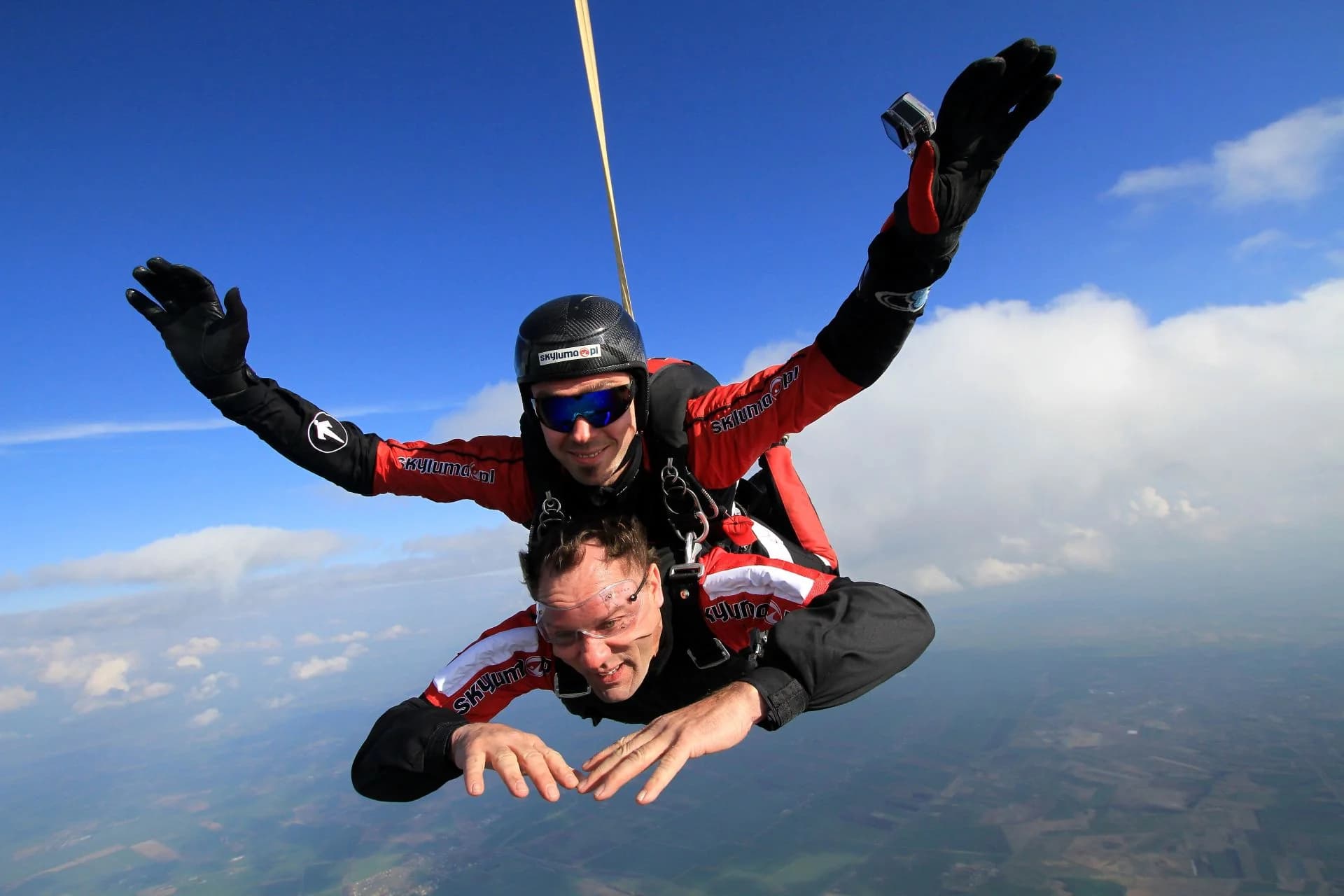
About 60 seconds of freefall at up to 200 km/h is loud and fast, and it takes most of your attention. The horizon tilts and turns; the picture is wide and rushing rather than detailed. Under the canopy you have several minutes, slow and without the noise. That is the first point at which you can choose what to look at.
What is actually down there
Water is the first thing the eye finds on any day with distance in it. It is darker or brighter than everything around it, and haze takes it last. Far off at the coast, the line where sand meets water holds after the towns beside it have blurred. The rest reads from large shapes down to detail, and it is the shapes that stay with you.
- The Bay of Gdańsk — in good visibility, a darker sheet lying out on the horizon.
- The Vistula delta — ruled into squares by ditches, tree lines and rectangular fields, in any season.
- The Vistula — a silver line, holding its edge long after the towns have lost theirs. The wind and the jump run decide whether it is ahead of you.
- The Tricity — a grey band pinned between forest and water, with no buildings you could name.
- Kashubia — lakes scattered through dark forest to the west. The pattern is unmistakable; a single lake is not.
- Forest — large, even masses that hold their shape in haze better than towns do, because each is a block of tone.
The Hel Peninsula sits well inside the geometric range, but you look at it across the bay and along the whole length of the haze. So it shows up in exceptional visibility and not otherwise. We do not promise it, or anything else on that list — a voucher is bought months ahead, and the weather is not for sale. The dropzone's position relative to the coast is on the Baltic coast page.
Can you see the curvature of the Earth from 4,000 metres?
No, and that is arithmetic rather than opinion. At 4,000 metres the horizon drops two degrees below eye level, about the width of a finger held out at arm's length. Curvature does not become arguable until something like 10 kilometres up. The claim turns up constantly in skydiving copy, which does not make it true.
Low sun does more for the view than clear air alone
Early and late, the light rakes across this landscape. Water flashes silver. Ditches, field boundaries and the slight relief of Kashubia throw shadows that an overhead sun erases. Morning air also tends to be steadier, before the day stirs the lowest layer. What the hour changes in practice is set out in the season and weather guide.
The same landscape through the year
How far you see changes with the weather. What you see changes with the season, and it changes a great deal. What follows is about fields, forest and water — it is not a calendar, and nothing in it says when we jump.
- Late April into the first days of May — the winter rapeseed comes into flower and whole rectangles of field go acid yellow.
- May and June — the widest range of greens in the year, with cereals standing at several stages at once.
- July and August — harvest makes a chequerboard of gold, pale stubble and bare earth, field by field.
- September and October — the Kashubian beech and oak turn colour under a sun that stays low all day.
- Winter — lying snow is not reliable on this coast. When it comes, field edges and forest boundaries go black and white.
Read next
Frequently asked questions
How far can you see from 4,000 metres?
About 226 kilometres is where the geometric horizon sits, but that is a ceiling, not how far you will see. The air cuts it to tens of kilometres, and behind a cold front you see further.
Can you see the sea on a skydive?
We jump inland, a few dozen kilometres from the coast. On a clear day the Bay of Gdańsk is out on the horizon, and everything from the exit to the landing happens over farmland.
Can you see the curvature of the Earth when skydiving?
No. The horizon drops two degrees below eye level at that height, and curvature does not become arguable until something like 10 kilometres up.
What can you see during freefall?
Not much in detail. About 60 seconds at up to 200 km/h gives a wide, rushing picture; the landscape resolves once the canopy is open.
Can you see the Hel Peninsula?
Sometimes, in exceptional visibility. You look at it across the bay and along the whole length of the haze, so nobody can promise it when you buy a voucher.