Where to skydive in Poland
No league table and no names. Seven things genuinely differ between dropzones, and one question settles each of them before you pay.
On this page
Where to skydive in Poland comes down to seven things, and only one of them is how far you drive. The other six are the exit altitude, the aircraft, the ground under the canopy, what a group is charged, what a quoted figure covers, and how the jump is filmed. No dropzone is named below, because a ranking written by somebody who sells jumps always finishes in the same place.
Altitude, and what it costs in seconds
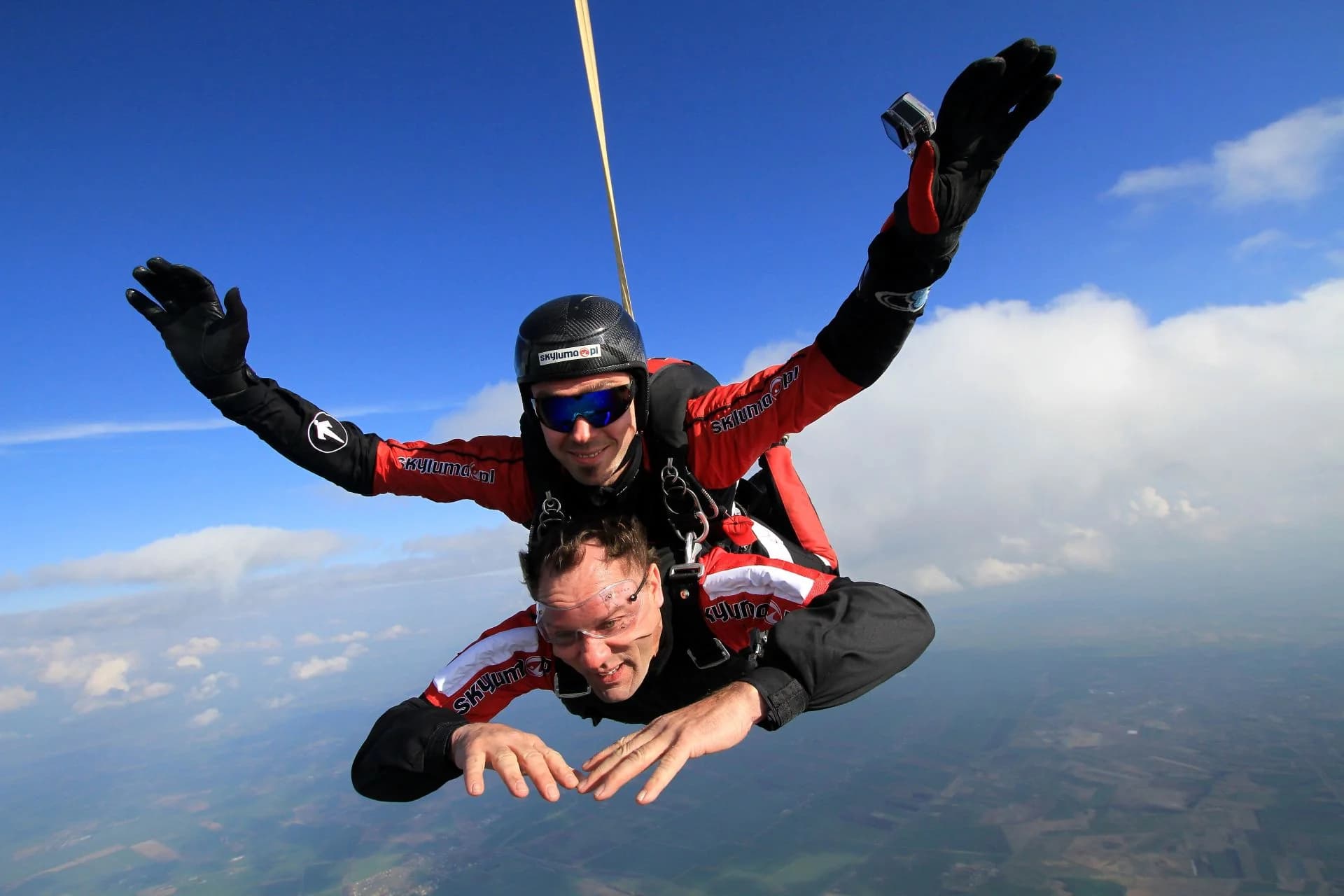
On a tandem, full altitude is 4,000 metres, which is where around 60 seconds of freefall comes from. A lower exit is cheaper — and the saving is not cosmetic. The canopy opens at much the same height whatever the exit, so everything taken off the top comes out of the freefall. Go low enough and it is seconds rather than about a minute. A price tells you little until the altitude is standing next to it.
The aircraft sets the length of your day
The aircraft settles two things almost nobody asks about: how long the climb takes, and how many people go up on one lift. Around twenty minutes to full altitude is usual, and a slower aircraft takes longer. The fewer seats on board, the more lifts before your turn. So the useful question is not the aircraft type. Ask how many jumps the dropzone runs in a day — that decides whether you spend a few hours there or the whole day.
The landscape is the part price cannot fix
This is the question a website is worst at answering, and the one most people have in mind when they picture the jump. Freefall is wide and rushing, and the airflow takes most of your attention. The detail arrives afterwards, under an open canopy, over several minutes in which you can turn your head. So the view you are choosing belongs to those minutes — and in Poland the ground under the canopy comes in four kinds.
- Coast — the line between land and water is the hardest edge in this landscape, and it holds long after fine detail has gone.
- Lakes and forest — dark blocks with brighter water set into them, still readable when the air is not clear.
- Farmland — the geometry of field boundaries, ditches and tree-lined roads; the ground whose colour changes most through the year.
- Rolling country — relief that shows under a low sun and flattens to one tone by midday.
A view of water is not a jump over water. A dropzone can sit a few dozen kilometres inland and still have the sea on its horizon. If the coast is your reason, ask how far from the shore the dropzone sits rather than judging by a photograph. No view is guaranteed — the day decides visibility, not a website. What you can actually make out from that altitude is its own question, answered in what you can see from 4,000 metres.
Travel time against a date the weather can move
Travel is a cost you count once and pay twice. Conditions are judged on the day, so a date can move — and that turns distance into a second journey. A dropzone forty minutes away absorbs that at almost no cost; three hours away costs a day. Ask how long a voucher stays valid, because what counts is not one perfect day but how many attempts fit inside that window. What actually stops jumping is set out in when we jump.
If you are going as a group
A group changes two things at once. The first is price: a discount often applies across the whole order rather than per person. So ask whether different variants can go in one basket, or whether everybody buys separately. The second is the day itself, and whether the dropzone can keep you together on the manifest. Both fit in one e-mail, and how specific the answer is tells you a good deal about the place.
What a quoted price actually contains
The figure on a website is often the price of the jump rather than the price of the day. Before you set one against another, check what is inside each of them.
- Altitude: without it, the figure means nothing.
- Dropzone entry and equipment: in the price, or paid on arrival.
- Insurance: whether there is any cover at all, and what it actually includes.
- Video: a separate line, and worth comparing on its own.
- Invoice and VAT: relevant the moment a company is buying.
- Travel, and a night's accommodation if it comes to that: in no price list, and still a cost.
How the filming is sold
Filming is almost always a separate line, because somebody else has to do it for you. Nothing is carried in your hands on a tandem, so filming yourself is not an option — regulation, not sales policy. A camera flyer is a second skydiver on the lift; a hand-cam rides in the instructor's hand, close to your face. The first shows the jump, the second shows you. Ask in what form the footage reaches you, and how soon.
Where we sit in this
We jump from 4,000 metres near Gdańsk, a few dozen kilometres from the coast. That means full altitude and around 60 seconds of freefall, and it means you look out at the water rather than down at it. Prices and what sits inside them are on the pricing page, and how a day runs is on skydiving near Gdańsk. Everything else on this page is about how to choose, and it holds whether you choose us or somebody else.
What to ask before you pay
None of the seven questions needs any knowledge of parachutes. All of them fit in a single e-mail, sent before you pay for anything. If the limits themselves are the question, age and weight are on the requirements page.
- What altitude the jump exits from, and how much freefall that gives.
- How long the climb takes, and how many jumps the dropzone runs in a day.
- What is under the canopy, and how far the dropzone sits from whatever you came to look at.
- How long the journey really takes, if it has to be made twice.
- Whether a group can be kept together on the day, and how the discount is worked out.
- What exactly the price includes, and what is paid on arrival.
- How the jump is filmed, and in what form the footage reaches you.
Read next
Frequently asked questions
Where is the best place to skydive in Poland?
There is no single one, and a ranking written by a company that sells jumps always puts that company first. What decides it is the exit altitude, the landscape under the canopy, the real travel time and what the price includes.
What altitude does a tandem jump exit from?
4,000 metres, if it is full altitude — that is where around 60 seconds of freefall comes from. A much lower exit gives seconds rather than about a minute, which is the first thing to check when you compare prices.
Can you skydive over the sea in Poland?
No, not over the water itself. That is a different exercise with different permissions, and dropzones sit on land. If the sea is your reason, ask how far from the shore this particular one is.
Is it worth travelling further for better views?
It depends on how many times you can make the trip. A date can move for weather, and at a distant dropzone one reschedule costs a second journey rather than a phone call.
What should a tandem price include?
Equipment, the instructor, the flight to full altitude and the briefing beforehand. Filming is almost always charged separately; travel and any accommodation sit outside every price list.