Aerodyne ICON: mandatory AAD cutter relocation before the next jump
Service Bulletin SB300426 of 30 April 2026 requires the AAD cutter to sit above the reserve pilot chute in ICON containers in sizes 1–5. In the UK, where ICONs were grounded after a fatal accident, British Skydiving set its own, in places stricter, conditions for a return to jumping.
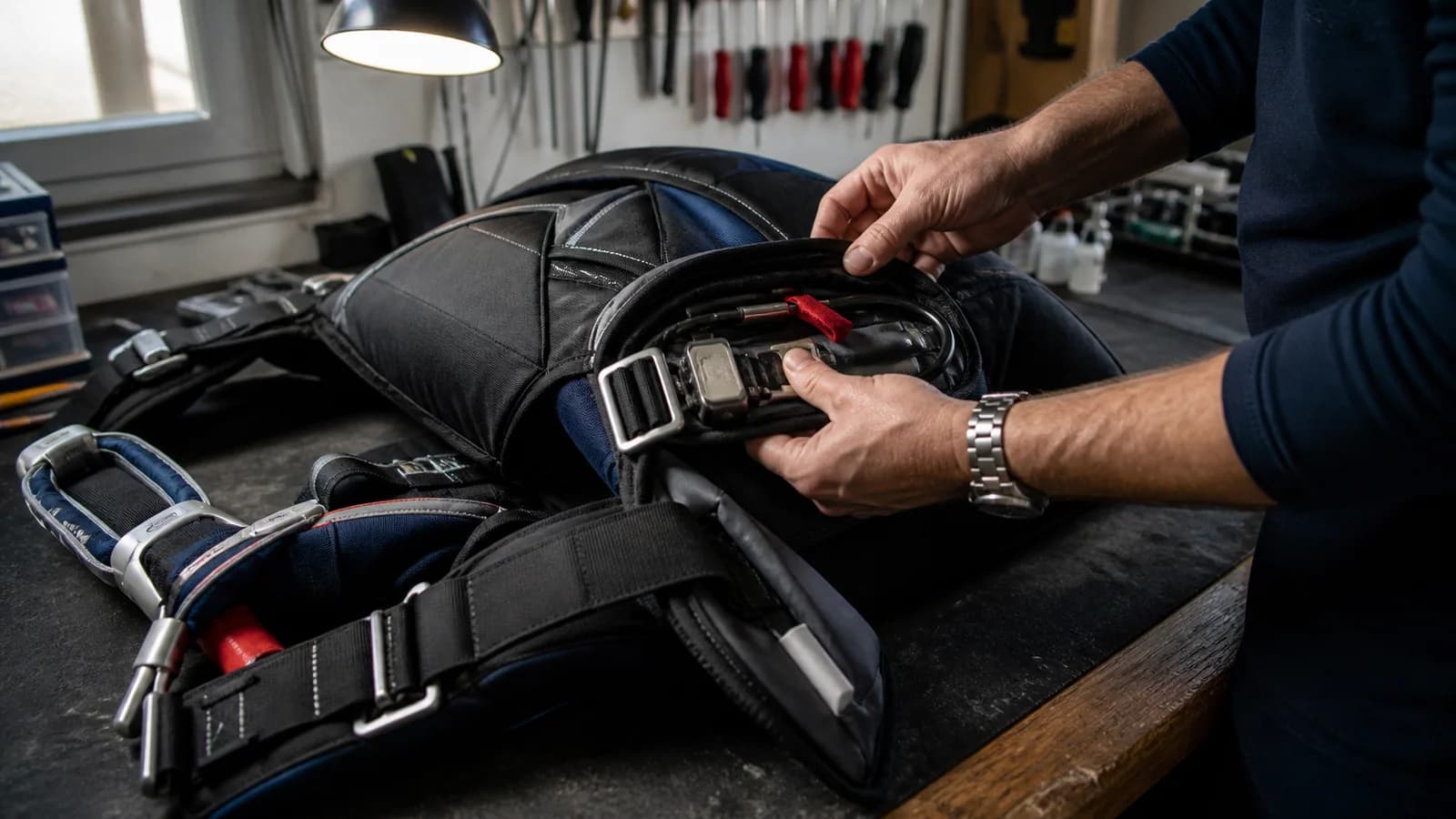 Photo
PhotoIn brief
- SB300426 is mandatory for ICON containers in sizes 1–5, including the LONG versions, and the change has to be made before the next jump.
- For sizes I6–I9 the new cutter position is optional.
- Additional British Skydiving conditions apply in the UK; in April the manufacturer said the available information did not allow the cause of the 6 April accident to be established.
Aerodyne Research, the Florida manufacturer of ICON containers, issued Service Bulletin SB300426 on 30 April 2026. It requires the cutter of the automatic activation device (AAD) to sit above the reserve pilot chute. This used to be a recommendation; it is now mandatory under the manufacturer's bulletin. The change has to be made before the next jump. A day later USPA, the United States Parachute Association, passed the information to its members and group member drop zones.
Which rigs the bulletin covers
The bulletin covers ICON containers in sizes 1–5 across two generations. For ICON NEXGEN these are models IX–I1 to IX–I5 / S5 and the ICON LONG in sizes 1–4, designated IX–I1L to IX–I4L. For the older PRE-NEXGEN generation they are models IN–I1 to IN–I5. The generation is shown on the rig's warning label: a NEXGEN serial number starts with ‘IX’ and a PRE-NEXGEN one with ‘IN’.
For sizes I6 to I9, Aerodyne authorises the cutter above the pilot chute as an optional configuration at the user's discretion. For those sizes the bulletin is not mandatory.
Where the cutter goes
On every rig covered, the cutter goes above the reserve pilot chute on the reserve container's right-side flap. The flap number depends on the version. On a NEXGEN it is flap 3. On a PRE-NEXGEN without a MARD (Main Assisted Reserve Deployment), meaning without flaps 2 and 2a, it is flap 2, and on a PRE-NEXGEN with a MARD it is flap 3 again.
Why the cutter's position matters
An AAD tracks altitude and rate of descent from air pressure. When the jumper is low and still falling fast, it cuts the loop that closes the reserve container, as Airtec, the maker of the CYPRES device, describes it. The spring-loaded reserve pilot chute should then launch freely and start the deployment. The ICON was designed and certified with the cutter below the pilot chute, on flap 1; Aerodyne approved the position above it as an alternative in 2008.
In bulletin TB-250122 of January 2022, Aerodyne described static ground tests in which an AAD was fired on fully packed rigs and, on certain ICON sizes, abnormalities in the deployment of the reserve pilot chute were recorded. The manufacturer noted that ground tests do not fully replicate conditions in the air and that, up to then, no incidents of the reserve system had been reported in live use. It recommended moving the cutter to flap 3 on IX-series ICONs in sizes I-1 to I-5/S-5.
On 19 April 2026 Aerodyne said both positions had been tested and approved and that the system had been in service for many years, including successful reserve activations in operational conditions. The requirement was introduced to make the configuration consistent across operating environments and jurisdictions. It also covers older IN-series ICONs, which the 2022 recommendation did not name.
What an owner does
- checks the serial number and size on the label, and does not jump an ICON in sizes 1–5 until the modification has been done and recorded
- takes the rig to a qualified rigger, the person certified to maintain and pack reserve parachutes, and does not modify it themselves, even though the bulletin includes the sewing procedure
- makes sure the logbook entry is there: date, description of the work, the rigger's name, certificate number and signature
- if unsure which version the rig is, stops jumping it and asks a rigger or the manufacturer
- before jumping abroad, also asks about the requirements of the country where they will jump
The UK: grounding and return to use
On 6 April 2026 a fatal accident occurred at one of the training centres affiliated to British Skydiving. On 10 April, following interim findings from the board of inquiry, the federation grounded all ICON containers at its affiliated centres. On 19 April Aerodyne said the investigation was continuing and that the available information did not allow conclusions about the cause of the accident or the performance of the equipment.
According to British Skydiving, SB300426 followed consultation and ground testing carried out in the UK. The UK rules then changed in stages:
- on 1 May 2026 (SN-02/26), sizes I4/S4 to I9/S9 returned to use once the SB300426 configuration had been installed and signed off by a British Skydiving Advanced Rigger, while I1–I3 stayed grounded; rigs already endorsed with SB210108 or TB250122 were treated as compliant
- on 21 August 2026 (SN-03/26), the federation published return-to-use conditions for I1–I3, different for three groups of models, including a required cutter position, a flap modification under TB220526 for some models, and a check pull of the reserve handle and a check AAD activation on a fully packed rig, with a video of the activation going to the owner
An illustration in the August notice labels the SB300426 cutter position as unacceptable for sizes I1–I3. For those sizes the UK requirements therefore differ from the manufacturer's bulletin. They apply at centres affiliated to British Skydiving, and none of the documents discussed here concerns Polish rules.
A new bulletin, this time optional
On 22 May 2026 Aerodyne issued Technical Bulletin TB220526 for all ICON containers. The manufacturer says differences in pack volume, packing technique and canopy-to-container combinations can make similar rigs behave differently in ground tests, and offers owners with concerns an approved modification to the reserve top flap. The bulletin is advisory and not required for continued airworthiness unless a skydiving association or local authority requires it, as British Skydiving did for some I1–I3 containers.