Indoor Para Skydiving's first FAI World Cup is decided: Niko Johann wins in Lesquin
FAI's first recognised para discipline held its debut World Cup in a wind tunnel near Lille in April 2026. Germany's Niko Johann won, and the programme of the 2027 world indoor championships in Germany already includes the event.
 Photo
PhotoOn 11 February 2025 FAI announced that it recognised Indoor Para Skydiving as its first discipline for athletes with disabilities, a decision taken at the Skydiving Commission's 2025 annual meeting. The debut was set as a World Cup in 2026, with the first world championships in 2027. In Lesquin the cup ran alongside the indoor formation skydiving events, and the 1st FAI European Championships in the discipline were held at the same time.
A race to four targets
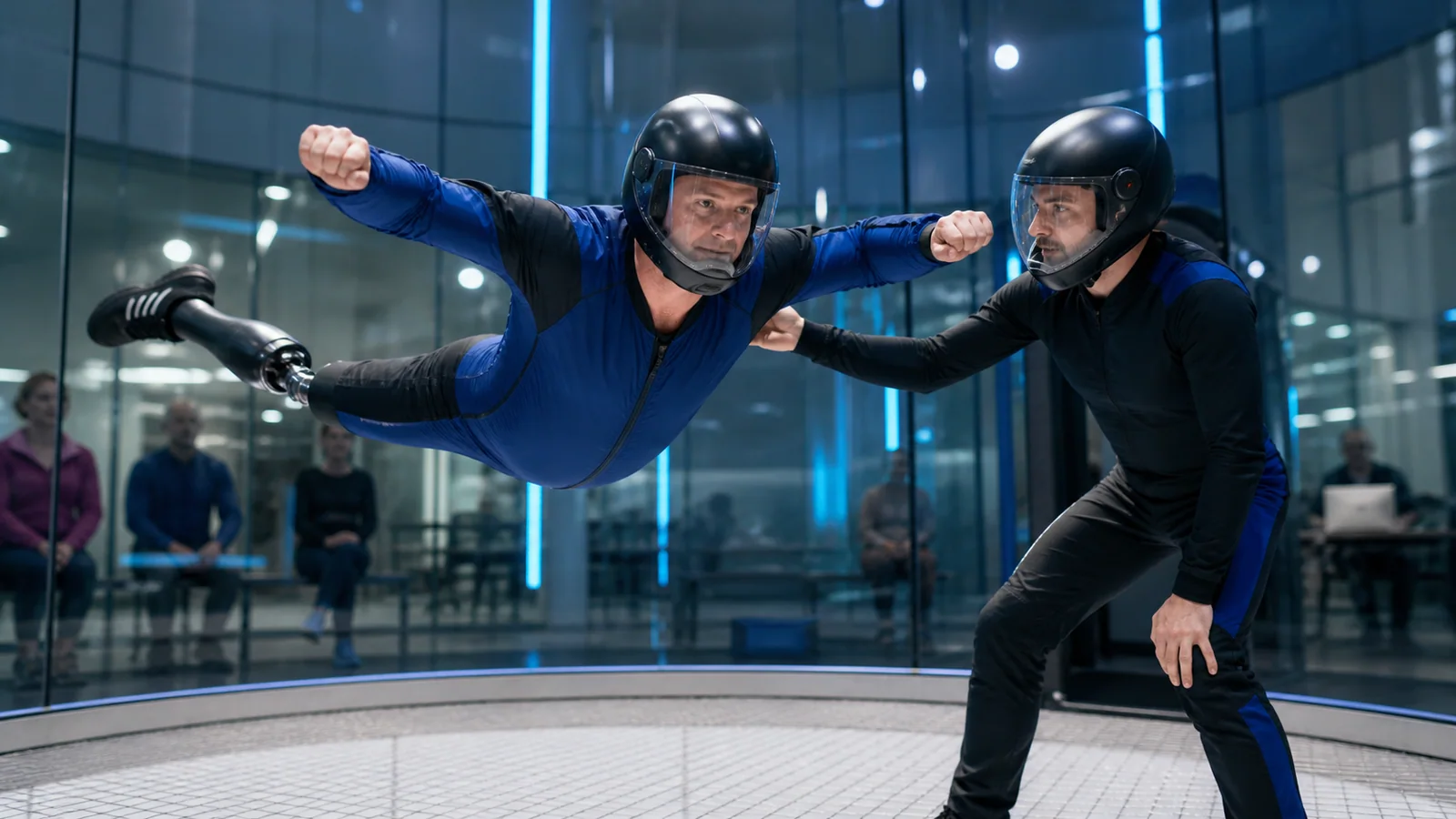
The athlete flies belly to earth in the tunnel and touches four sensor targets on the walls of the flight chamber with a hand, in the order set by the course. Some legs are single targets; others are blocks, two targets linked by a compulsory intermediate manoeuvre. A target changes colour when validated, and a touch made with an instructor's help does not count.
The fastest time wins. The limit is 75 seconds in qualifying and the semi-final, and 150 seconds in the final, whose course is longer. Instructors stay in the chamber throughout and may help with entry, stabilisation or safety. Assistance costs a single 5-second penalty, each infringement of the course another 5 seconds, and each omitted element 20 seconds.
One ranking, an individual coefficient
Athletes must have a health condition that leads to a permanent eligible impairment. Everyone competes in a single ranking, and the differences are evened out by a compensation coefficient that the Classification Board assigns after evaluating each athlete, taking account of activity limitation and aerodynamic factors. A flight's score is the time for the course multiplied by that coefficient, plus penalties.
The classification panel appointed for Lesquin had eight members, four doctors and four classifiers, trained in Marseille in November 2025.
How the competition unfolded
Everyone flew three qualifying rounds, with the best result counting. The top eight went through to the semi-final and the top four to the final. Johann was fastest in qualifying (7.92 s) and in the semi-final (8.09 s), and flew the longer final course in 16.04 s. Raineri recorded 18.59 s, Valenza 20.64 s, and fourth-placed Sabrina Schoenmaker of the Netherlands 20.87 s.
The athletes came from Germany, Italy, the Netherlands, France, Australia, Great Britain and Belgium; there were no Polish competitors. The ISC results portal does not show a separate European championship order: it lists the ten European participants alphabetically and refers to a PDF file that the page does not link to.
A French project with international rules
The discipline was developed in France, within the Fédération Française de Parachutisme, as a way of bringing athletes with disabilities into competition. According to FAI, the project received €500,000 from the EU's Erasmus programme in 2022. The competition rules have applied since 1 May 2025, and the ISC Bureau approved the Lesquin World Cup in June 2025. Outside FAI events there is a World Series, with seven stages in the 2025–2026 season, from Lille and Prague to Sydney.
What to watch next
In January 2026 in Riyadh the commission awarded Germany the world indoor championships in Taufkirchen, near Munich, on 15–20 March 2027, and the organiser's bid includes Indoor Para Skydiving. Delegates also backed CHF 2,500 for a world ranking in the discipline from 2027. Those championships will be the first test of whether the coefficient system produces comparable and fair competition at the highest level.