Parachute and giant slalom on one scorecard: Austria takes four of five titles
The 19th FAI World Parachute-Ski Championships ended on 15 March 2026 in St. Johann im Pongau. The medals were decided by two giant-slalom runs and five rounds of accuracy jumps; the official results contain no sixth round and no final.
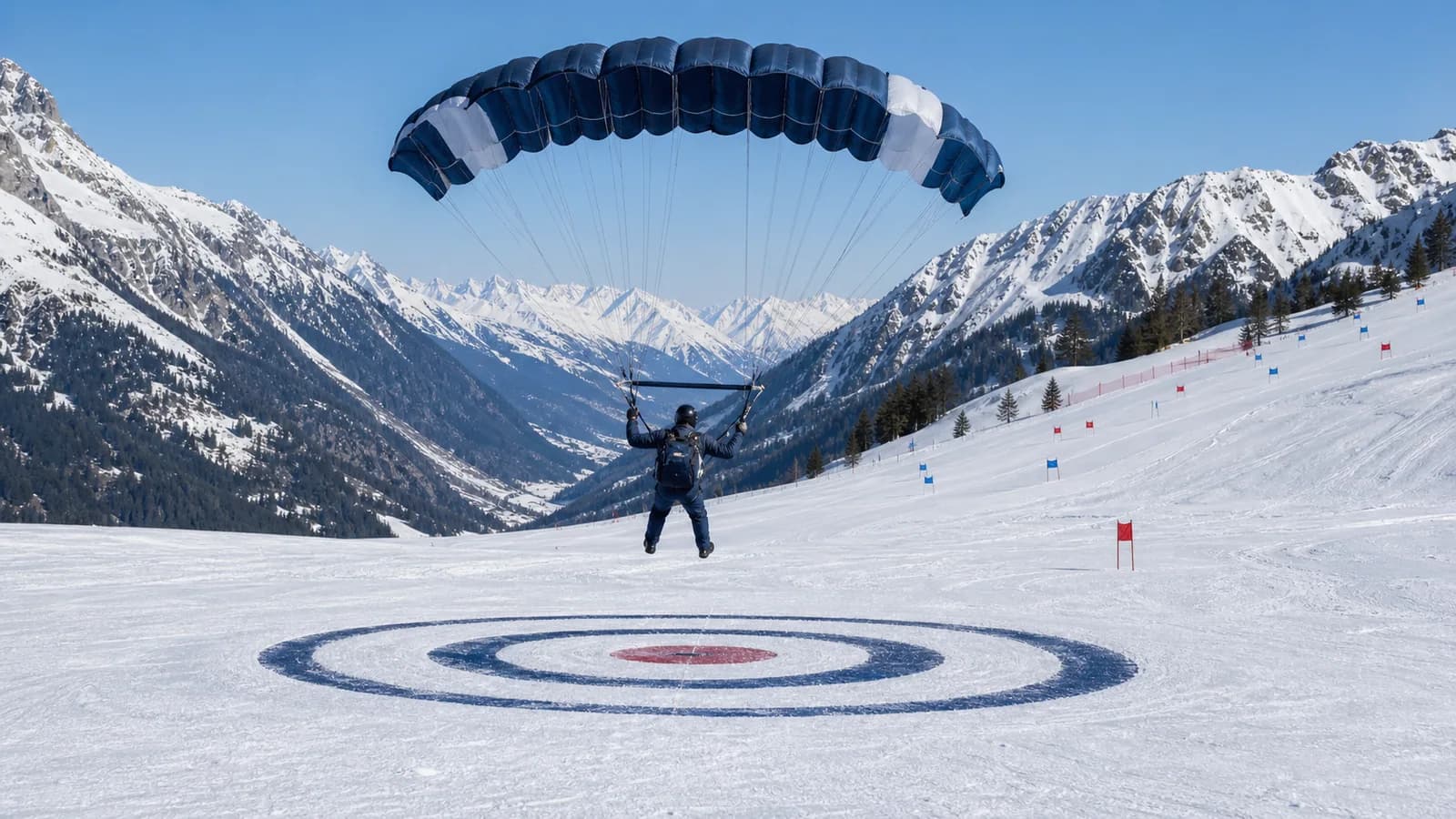 Photo
PhotoThe 19th FAI World Parachute-Ski Championships ended on 15 March 2026 on the slopes of Alpendorf in St. Johann im Pongau, in the Austrian state of Salzburg. Parachute-Ski is a combined event: the result adds parachute accuracy to the time from two giant-slalom runs. Austria won four of the five classifications: women, men, juniors and teams.
The medallists
- women: Sophie Grill (Austria), Magdalena Schenner (Austria), Christina Franz (Switzerland)
- men: Sebastian Graser (Austria), Reinhold Haibel (Germany), Andrin Frei (Switzerland)
- juniors: Michael Urban (Austria), Ionut Mihnea Rites (Romania), Ondrej Zvedelik (Czech Republic)
- masters: Reinhold Haibel (Germany), Anton Gruber (Austria), Stephan Lehner (Switzerland)
- teams: Austria 1, Switzerland 1, Austria 2
Centimetres and seconds on one table
In the parachuting half, teams of four jump from 1,000 m above a target set on a slope; FAI gave the gradient as 30 degrees, and the rules allow up to 35. The organiser's bulletin planned jumps from a helicopter carrying four parachutists, a whole team. What counts is the first body contact with the ground: each centimetre from the edge of the 2 cm dead-centre disc is a penalty point, a landing on the disc scores zero, and measurement stops at 30 cm.
The giant slalom is run under the rules of FIS, the International Ski Federation. The winner of each run scores zero and every half-second behind costs a point, up to 90 per run. The champion is whoever has the lowest combined total.
Five rounds, not six
The championship programme provides for six team accuracy rounds and an individual final for the leaders. The results signed on 15 March by Chief Judge Ulf Tingnert, however, cover five rounds, and the columns for the sixth round and the final are empty. The rules make the event valid after as few as two accuracy rounds and one slalom run.
The championships had a false start. According to the minutes of the ISC plenary meeting in January 2026, the event held at the same venue in March 2025 could not be completed because of poor weather and was moved to 13–15 March 2026.
Where the titles were won
Sophie Grill won both women's slalom runs, so she lost nothing on the slope, and collected 16 penalty points in accuracy. Magdalena Schenner was the most accurate woman with 15 points, but 22 slalom points left her second. Sebastian Graser also won both runs and his 14 points were the lowest total of the championships.
Reinhold Haibel reached the podium twice: second among the men on 29 points, and winner of the masters, where slalom points are recalculated against the fastest skier in that category. The best accuracy among the men belonged to Romania's Ionut Mihnea Rites, just 7 points over five jumps, but 87 points lost on skis dropped him to 23rd. Among the juniors he was second.
There were 44 competitors, 9 women and 35 men, from six countries (Austria, Germany, Switzerland, the Czech Republic, Italy and Romania), plus 10 teams. No Polish competitors appear in the results. The organisers were the HSV Red Bull Salzburg club and the Austrian Aero Club, which marks its 125th anniversary in 2026.
From mountain rescue to world titles
FAI traces the discipline to mountain rescue in the early 1950s, when no sufficiently powerful helicopters were available. Equipment and skis were dropped from aircraft, and rescuers jumped on round canopies and had to land on the slope as close as possible to their skis. Real missions were rare, so friendly cross-border contests grew up alongside training, then a World Cup, and from 1987 official FAI world championships.
In the 1987–2023 championship medal table that FAI links to, Austria has 77 medals, 28 of them gold, ahead of Slovenia with 46. The 2026 results fit that picture.