USPA sharpens tandem safety requirements
Since 1 June 2026, a tandem instructor holding a USPA rating must carry a hook knife, and the aircraft must carry one too. The six-monthly procedure review now also covers harnessing the student, gear checks, hook-up and exit.
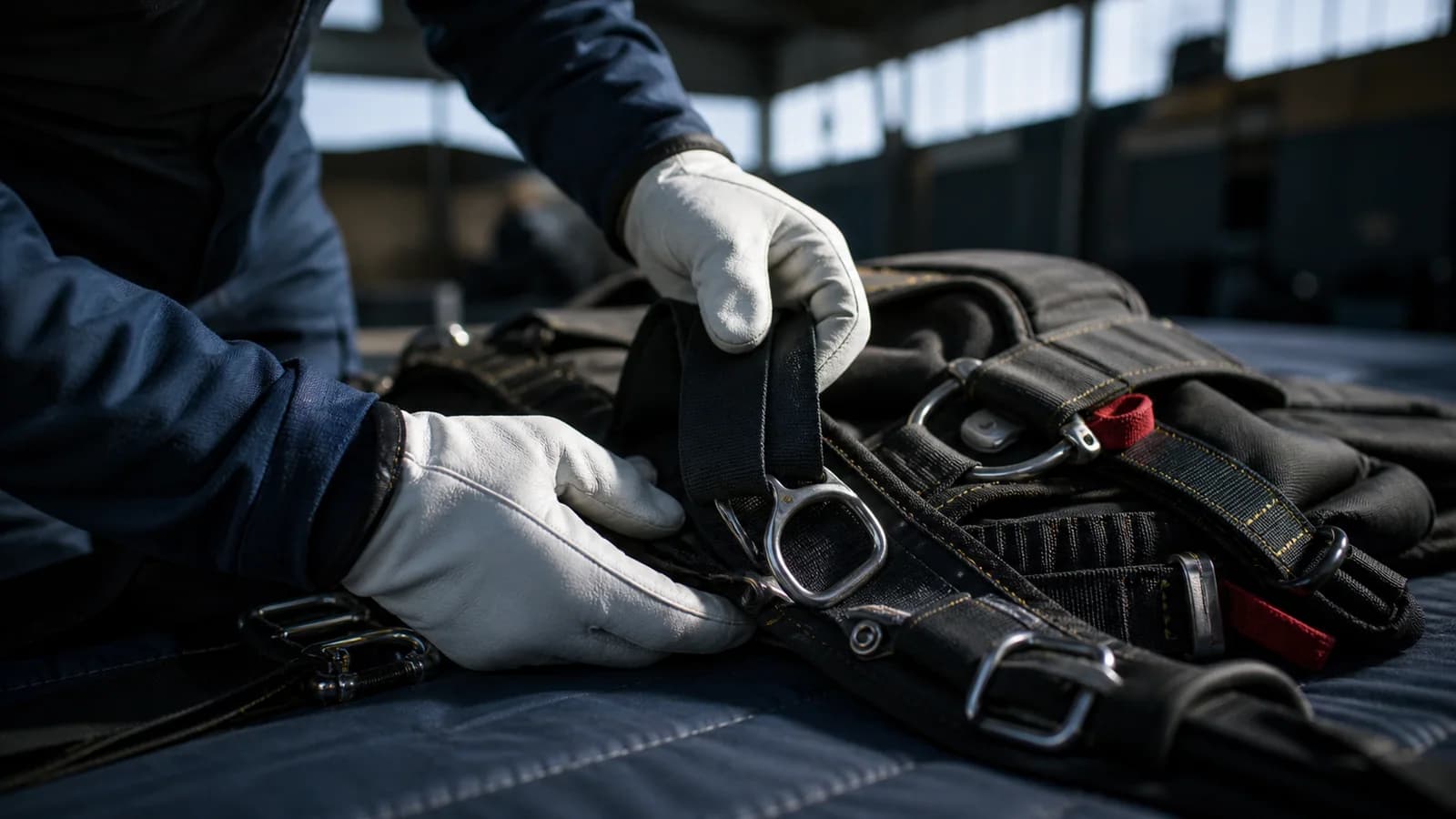 Photo
PhotoThe board of the United States Parachute Association (USPA) reviewed recent tandem incidents and tightened its requirements for instructors. Since 1 June 2026, anyone flying a tandem as a USPA-rated instructor must carry a readily accessible hook knife. Every aircraft used for skydiving must carry a knife that can do the same job.
In brief
- since 1 June 2026, a hook knife able to cut Type 7 webbing on the instructor and in the aircraft
- the six-monthly emergency procedure review also covers harnessing the student, gear checks, hook-up and exit
- these are the rules of a US membership organisation, not Polish law
What the new rules say
The board adopted both changes unanimously at its meeting in Los Angeles on 13–15 February 2026. The knife requirement went into USPA's Basic Safety Requirements (BSRs), in the section on parachute equipment. On every tandem skydive, the instructor must have a readily accessible hook knife capable of severing Type 7 nylon webbing or its equivalent. Every aircraft used for skydiving must carry a knife of the same capability, accessible to the pilot and everyone on board.
The January edition of the 2026 SIM, the manual in which USPA publishes the BSRs, predates the decision and does not contain the new item. Its wording appears in the 2026 Instructional Rating Manual (IRM), in the chapter that restates the rules in force.
The second change concerns rating renewal. A tandem instructor must complete a full review of all emergency procedures every six months, demonstrating the response to each malfunction in a training harness. Since 1 June, malfunction responses are practised with simulated handle pulls, and the review also covers harnessing the student, gear checks, and hook-up and exit in the aircraft. Every demonstration must follow the manufacturer's procedures for the system in use.
Why a knife, and why Type 7
A hook knife has its blade on the inside of the hook. The SIM describes it as a tool used in certain emergencies to sever problem lines or components of a parachute system. The rationale recorded in the board minutes refers to accidents involving tandem students, fatalities among them, that a knife carried by the instructor and another in the aircraft might have prevented. The board listed the situations in which the knife must be at hand: reserve line-overs, aircraft entanglements, student harness complications and hazards on board.
The minutes also note that tandem instructors are often seen without hook knives, even though knives were originally fitted to the equipment. During the discussion it was said that several organisations in other countries already require hook knives for licensed jumpers, and that manufacturers have recently reinforced similar equipment requirements.
Type 7 is a webbing designation from the US specification PIA-W-4088. According to the FAA's Parachute Rigger Handbook, it is about 4.4 cm wide with a tensile strength of about 2.7 tonnes (6,000 lb), and it is used for sport harnesses and risers. The rule therefore names no particular knife, only what the knife must be able to cut.
A chain of small errors
In the announcement of 9 April 2026, Angie Aragon, a USPA National Director and instructor examiner, wrote that most of the incidents reviewed did not result from rare equipment failures or unpredictable conditions. The most common contributing factors were delayed or incorrect emergency procedures, inadequate gear checks, improper student harnessing and the absence of a hook knife. USPA did not say how many incidents the review covered.
The association describes this as the Swiss cheese effect. A serious outcome rarely has a single cause; it usually comes from several small errors lining up. In several cases the last hole in that line was improper harnessing.
Whom it binds
USPA is a private membership organisation, and its manual states that it has no legal authority to regulate individuals or companies. Compliance with the BSRs is a condition of taking part in its programmes, and most US drop zones are affiliated with USPA. Some aspects of skydiving in the United States are also regulated by the Federal Aviation Administration (FAA).
The BSRs also cover jumping abroad. A USPA-rated instructor teaching outside the United States follows the BSRs unless they also hold the appropriate instructional rating of the country where the jump takes place. In that case they may follow the rules of that rating instead.
What it means for a passenger
In a tandem, the instructor is responsible for emergency procedures; USPA calls the instructor the parachutist in command. Yet the USPA review also concerns tasks a passenger sees at close range: fitting and tightening the harness, the gear check before boarding and the hook-up to the instructor before exit. USPA treats them as the foundation of safety and has written them into the regular check of instructors' skills.